In the heart of Stelvio National Park, above Santa Caterina Valfurva, the Forni Valley opens up like a vast natural amphitheatre dominated by the Forni Glacier and the peaks of the Ortles-Cevedale group. Smoothed rocks, moraines, glacial streams and valleys tell a story shaped by ice and time.
But the landscape here is not only about geology. Along the trails, you can also find traces of the First World War, while mountain huts and high-altitude routes are a reminder that this valley has long been one of the gateways to the world of mountaineering.
There are many ways to explore the Forni Valley. You can walk at a leisurely pace, observing what the glacier has left behind, or take on the rock from a more vertical perspective. You can follow the traces of those who lived and fought here more than a century ago, or aim higher, towards the summits.
Here are 5 ways to experience the Forni Valley.


1. Walk at the foot of a giant: the Forni Glacier
In the Forni Valley, the glacier takes centre stage rather than simply forming the backdrop.
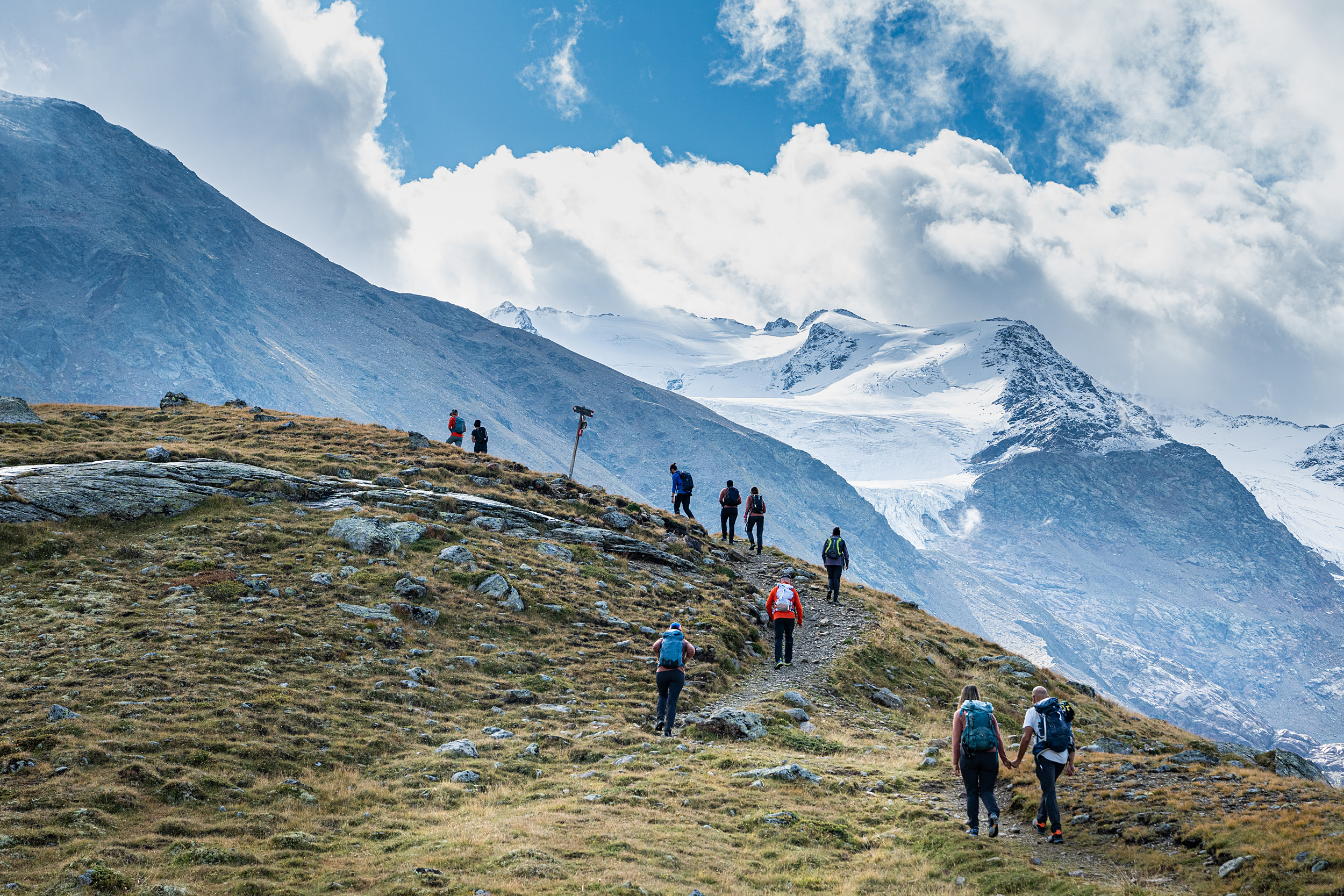
To discover the valley, you can follow the Forni Glaciological Trails, choosing either the upper or lower route. These are two different trails starting near the Forni mountain hut and leading you closer to the glacier, with the Ortles-Cevedale massif always in view.
Walking here is above all about learning to read the landscape.
Look at the debris deposits along the slopes, the rocks shaped by the ice, the small streams and the areas that, until relatively recently, were still covered by the glacier. Each element reveals something about the valley's evolution and makes it possible to see just how powerfully glaciers have shaped these mountains.
Along the lower Glaciological Trail, for example, you pass close to a small lake in an area reached by the glacier little more than a century ago: a detail that gives you a very tangible sense of how constantly this environment is changing.
Here, geology is not only part of the past. The transformation is still happening.


2. Cross the suspension bridges
At a certain point, the trail changes character.
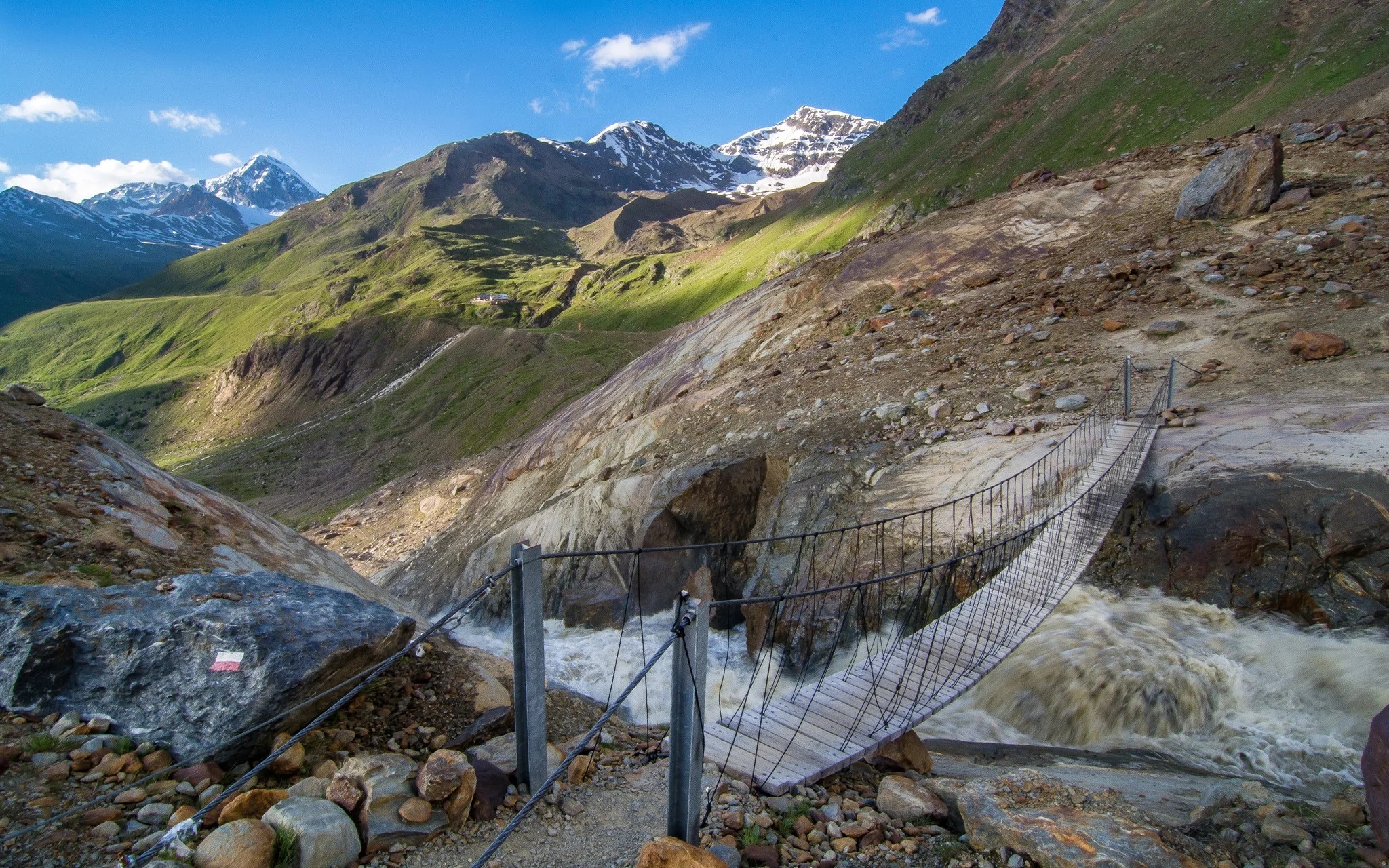
Beneath your feet flows water from the glacier. Ahead of you, the outline of the mountains. All around, rock and the sound of the rushing stream.
Along the upper Glaciological Trail, a series of suspension bridges cross the Frodolfo stream, making this one of the most exciting and scenic sections of the Forni Valley.
The bridges allow you to cross waterways fed by glacial meltwater and observe the ever-changing morphology of the valley even more closely. Water, ice and rock are closely connected, constantly reshaping the landscape from one season to the next.
Crossing them means spending a few moments suspended above an environment in continuous transformation.


3. Try the new Jacopo Compagnoni Via Ferrata
Since 2026, there has been a new way to discover the Forni Valley: by taking it on vertically.
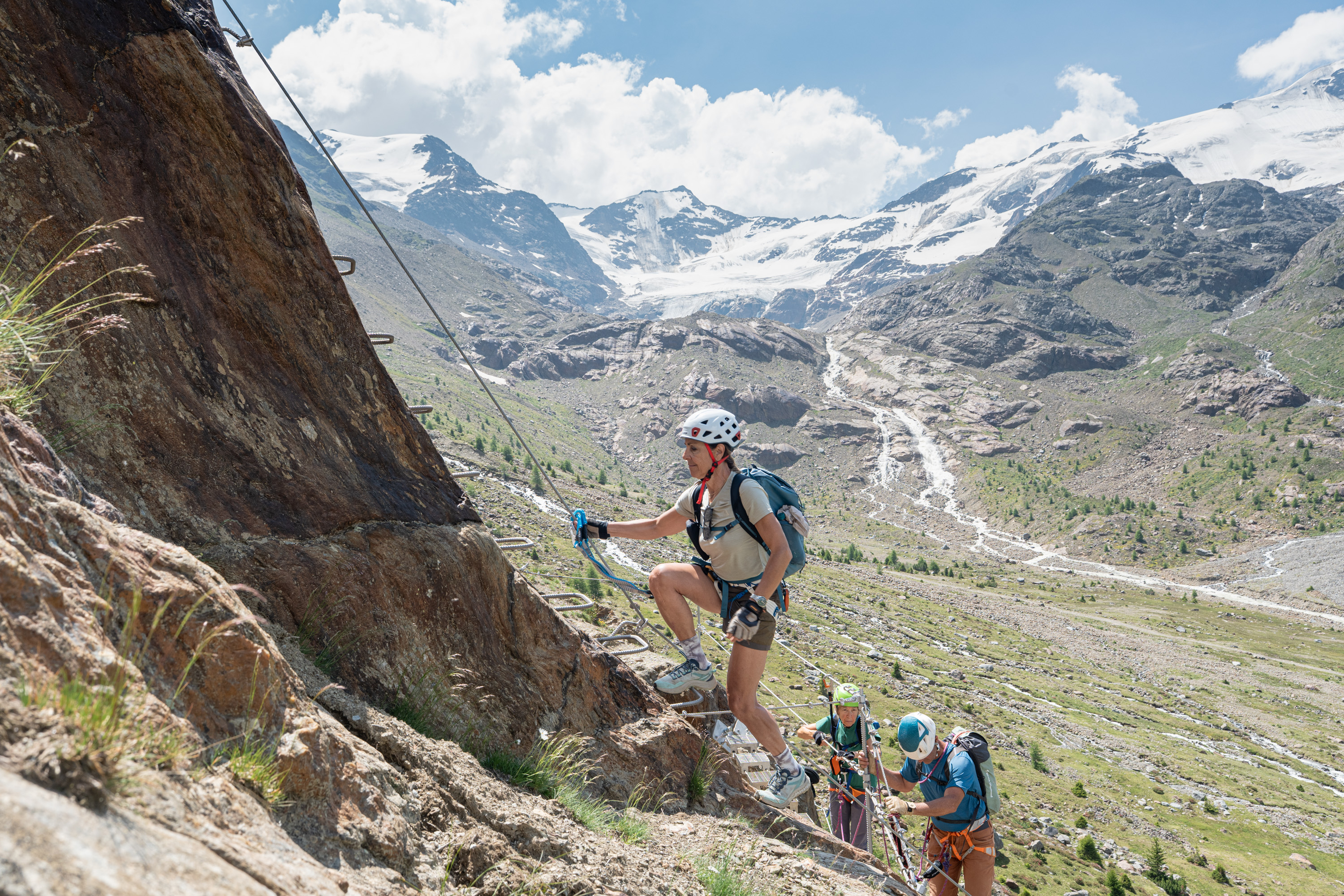
The new Jacopo Compagnoni Via Ferrata follows the rocky spurs in the area between the Forni and Branca mountain huts, at the foot of the great glacial faces of the Ortles-Cevedale group. It is a modern route divided into two sections and can also serve as an introduction to Alpine via ferratas for those who are already familiar with the mountain environment and know how to use the required equipment correctly.
Steps, slabs, traverses and more exposed sections continuously change your perspective on the valley.
Here, you experience the landscape in a different way: not simply by walking through it, but by following the shape of the rock itself, while behind you the view opens out across the glacier.
The via ferrata is classified EEA and requires a helmet, harness and certified via ferrata set. If you do not have experience, or if you would like to tackle it with greater confidence, you can choose to go with the Alpine Guides.
An adrenaline-filled experience, but above all a new perspective on one of the most spectacular environments in Alta Valtellina.


4. Walk through the history of the White War
Today, the silence of the Forni Valley is broken mainly by water, wind and the calls of wildlife.
A century ago, life in these mountains was very different.
During the First World War, the front also crossed the high-altitude areas of the Ortles-Cevedale group. Soldiers and military units operated in extreme conditions, often above 3,000 metres, amid snow, ice and bitterly cold temperatures: a chapter of history remembered as the White War.
Its traces are still visible in the landscape.
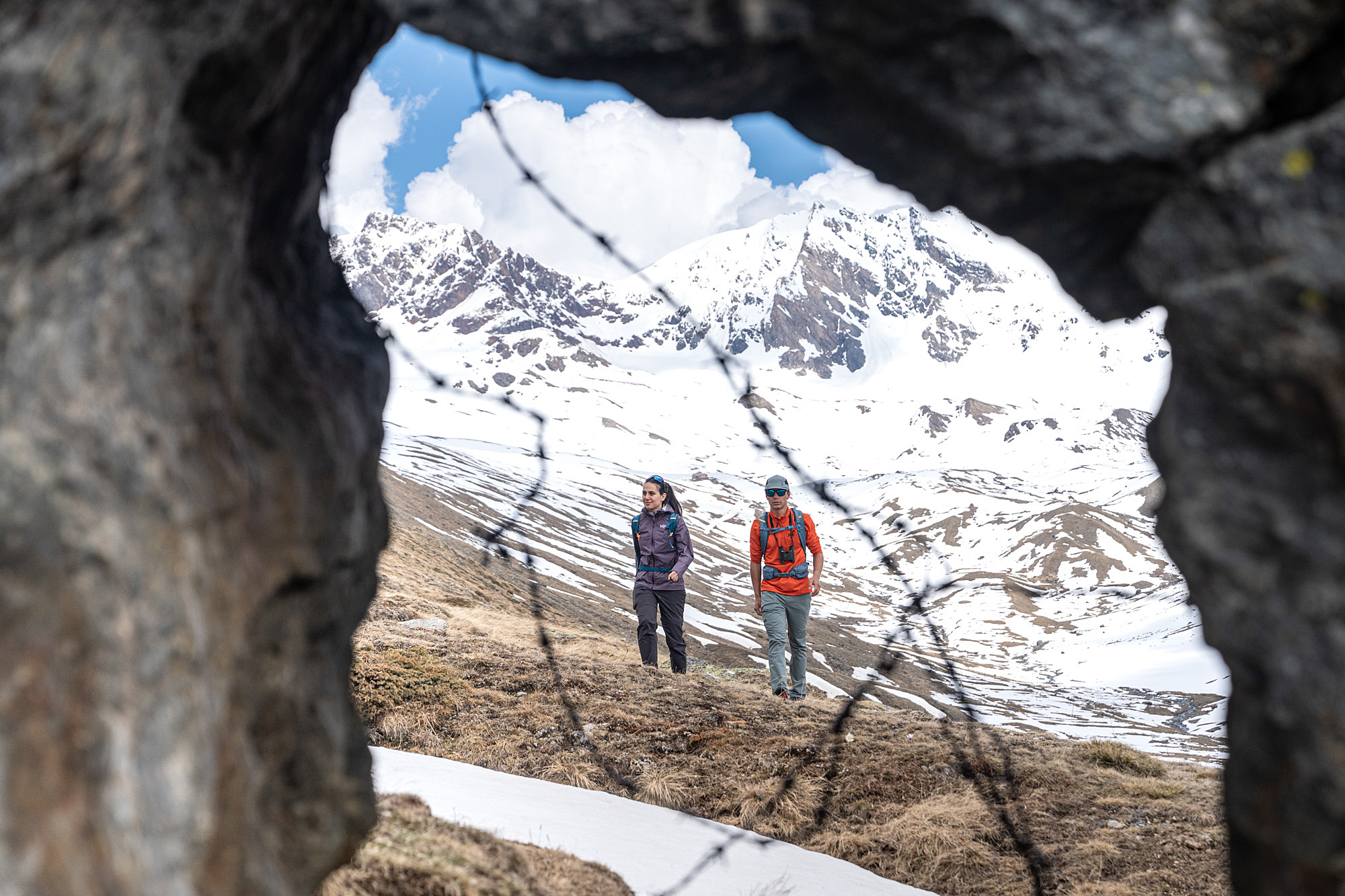
Along the upper Glaciological Trail, you can come across the remains of military positions, while other routes in the area lead past trenches, mule tracks and further evidence left by the conflict.
It is precisely this contrast that gives these places such intensity.
Where today you walk while looking at a glacier or stop to admire the view, very young men once spent incredibly difficult months in an environment that could be just as dangerous as the fighting itself.
The mountains preserve the traces of the ice, but also those left by people.


5. Step into the world of high mountains
At some point, whichever trail you have chosen, stop and look up.
The Forni Valley is surrounded by high mountains. In front of you are not simply peaks to photograph, but one of the great mountaineering areas of the Alps, dominated by the Ortles-Cevedale group.
This is where your perspective changes.
What appears to a hiker as a snow-covered ridge on the horizon becomes, for a mountaineer, a crest to follow, a glacier to cross or a summit to reach.
The Forni Valley is in fact the starting point for mountaineering routes leading towards some of the area's major peaks, including Monte Cevedale. In this context, mountain huts are no longer simply places to stop for a break, but bases for numerous ascents in the Ortles-Cevedale group: meeting points for hikers and mountaineers, and places from which to set off early in the morning towards walls, glaciers and summits.
Because the Forni Valley can be the destination of a walk or the beginning of a high-mountain experience.


If you want to go further...
The Forni Valley can also be the starting point, or one of the stages, of longer routes.
The Giro del Confinale connects the Forni area with Val Zebrù on a multi-day trek that also crosses Passo Zebrù, at over 3,000 metres. The Sentiero Confinale, part of the Bormio 360 Trekking route, instead follows the mountainside between the Forni mountain hut area and Val Zebrù along a route of around 21 kilometres.
For those looking for an even more demanding experience, there is also the Ortles Haute Route, a major high-altitude itinerary forming a long loop around the Ortles massif and crossing some of the most spectacular environments in Stelvio National Park, including Val Zebrù and the area around the Pizzini mountain hut, before continuing into South Tyrol and returning to Bormio. It is a route suitable only for very fit and experienced people accustomed to moving through Alpine terrain.