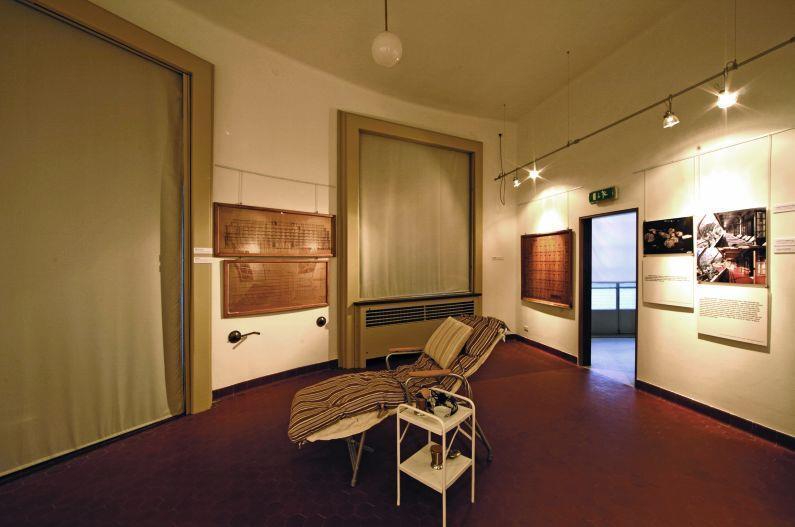
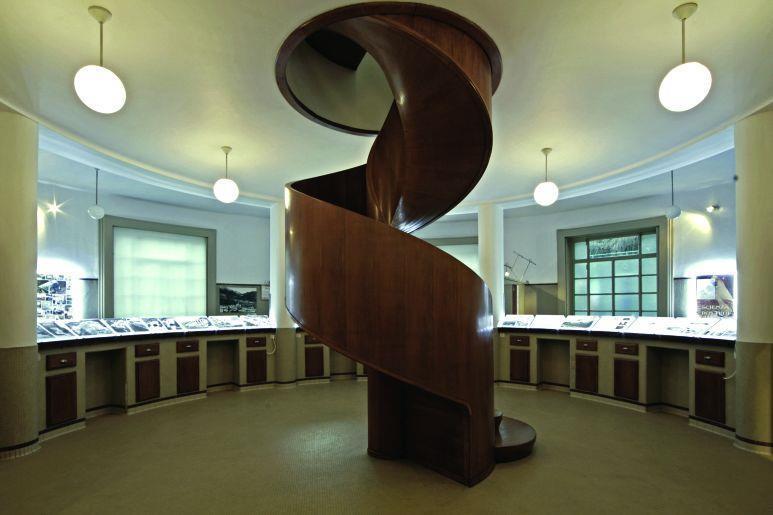
The museum tells the story of the sanatoria built in Valtellina during the twentieth century to combat tuberculosis thanks to the pure air and sun of the Alps. A collection of period objects and images testifies to the birth and activity of the former Sanatorium Village of Sondalo, now the "Eugenio Morelli" hospital. The visitor route takes place in the rooms that were once designated for patient admission.
During the opening days of summer 2026, the Museum hosts the permanent exhibition "The Buried Giant - The Stele of Migiondo," an important artifact from the Copper Age, one of the most significant artifacts of prehistoric archaeology in Lombardy, and the exhibition "Sortenna, the Breath of the Pine Forest" curated by the director and photographer Anna Tinti.
FIRST PART
The first part of the route is dedicated to disease.
Between the nineteenth and twentieth centuries, tuberculosis ceased to be considered a romantic disease – the 'subtle malady' – and became characterized as a real health emergency for the new industrialized and urban society. Since the 1960s, antibiotics have allowed for increasingly effective treatment, but TB is today a global disease that annually causes over one million deaths.
SECOND PART
The second part of the route is dedicated to treatment and sanatoria.
Initially, sanatoria were built to prevent contagion, comfortably isolating the sick. In the twentieth century, architecture developed according to the criteria of functionalism and aligned with medical evolution: air, light, and sun entered the buildings to strengthen the sick and promote healing. Treatment was based on rest, nutrition, and pure air, that is, on the three "L"... Wool, bed, milk. Until antibiotics were effective against infection, the sanatorium was the primary tool for treatment, a true machine à guérir. The design involved collaboration between the doctor and the architect.
LAST PART
The last part is dedicated to the Sanatorium Village of Sondalo. The complex operated as a sanatorium for 25 years, from 1946 until 1971, when it was transformed into a general hospital. The care objects in the veranda (the deck chair, blankets, headphones for listening to radio programs) are displayed alongside technical drawings and photographs of the large construction site that transformed the slope above Sondalo into a true health city between 1932 and 1940. The route concludes with the canvas "Fishermen at Sampieri," painted by the Sicilian Ugo Caruso in 1954, when he was hospitalized in Sondalo. The saturated colors, the stern gazes, and the imposing poses of the characters seem to vehemently allude to the contradictions and uncertain prospects of the 'outside' world, which, however, the author, isolated in the temporary alpine refuge, seems to look at with nostalgia.
OFFICIAL SOCIAL:
- Facebook: Museum of Sanatoria of Sondalo

- Instagram: Museum of Sanatoria of Sondalo